When Should You Worry About a Mosquito Bite?

Most mosquito bites are harmless, but increasing swelling, redness, warmth, or other symptoms may be a sign it’s time to seek medical care.
Medically reviewed by Keith Seibert, MD | Last Reviewed 8/3/26
When Should You Worry About a Mosquito Bite?
Quick answer: Most mosquito bites are harmless and heal on their own. See a doctor if a bite grows large and warm (a sign of Skeeter Syndrome (local reaction) or infection), or if you develop fever, headache, or body aches in the days after a bite, which can signal a mosquito-borne illness like West Nile virus. Seek emergency care for difficulty breathing, facial swelling, or a high fever with confusion or a stiff neck.
It’s normal to feel a little uneasy about a bite that looks bigger or itchier than usual, especially with mosquito populations testing positive for West Nile virus in parts of the Southeast this summer.
What a Normal Mosquito Bite Looks Like
A typical mosquito bite causes a small, raised, itchy bump with mild redness that appears within minutes and peaks the next day, then resolves within three to seven days. Washing the area, applying a cold compress, and using an over-the-counter antihistamine or hydrocortisone cream can ease symptoms while it heals. A bite that stays roughly the size of a pencil eraser and doesn’t grow or become more painful is not a cause for concern.
Skeeter Syndrome: When a Reaction Is Bigger Than Normal
Some people develop a much larger reaction to mosquito saliva, known as Skeeter Syndrome — a localized allergic reaction to proteins in mosquito saliva. It tends to appear faster than an infection would, typically 8 to 10 hours after the bite, according to the Asthma and Allergy Foundation of America. A reaction this size can look alarming, especially the first time you see one, but it typically looks like:
- Swelling that extends several inches beyond the bite, larger than a typical bump
- Warmth and intense itching at the site, sometimes with mild bruising or blistering
- Occurs mainly in children, older adults, and people with weakened immune systems
- Occasionally becomes systemic — widespread hives, fever, or swollen lymph nodes, with rare progression to a whole-body allergic reaction
The reaction itself isn’t dangerous for most people. It’s the immune system responding to saliva proteins, not a sign that anything is wrong internally, and it typically resolves on its own within three to ten days with basic care like a cold compress and an antihistamine. The exception is if it spreads beyond the local site: symptoms like widespread hives, fever, or swollen lymph nodes mean it’s time to seek medical care.
Skeeter Syndrome vs. a Normal Bite
The easiest way to tell them apart is size and speed: a normal bite stays small and calms down within a day or two, while Skeeter Syndrome swells noticeably larger, feels warm, and shows up within hours. If a bite is spreading past the size of a quarter and feels hot to the touch, treat it as Skeeter Syndrome rather than a typical reaction.
Signs of a Skin Infection at the Bite Site
A skin infection is a different problem entirely — it happens when bacteria get into broken skin, usually from scratching, rather than from anything in the mosquito’s saliva. Because of that, it behaves differently over time than Skeeter Syndrome: infection develops more gradually, typically 48 hours or more after the bite, and worsens rather than peaking early. Watch for:
- Redness that keeps expanding rather than fading
- Skin that feels increasingly warm or tender
- Red streaking extending from the bite
- Pus or cloudy drainage
- A fever that develops days after the bite, rather than within hours of it
Scratching a bite makes infection more likely by giving bacteria an easy entry point, so keeping bites clean — and covered, if a child is prone to scratching in their sleep — goes a long way toward preventing this outcome in the first place.
Signs of a Mosquito-Borne Illness Like West Nile Virus
West Nile virus is the most common mosquito-borne illness in the continental United States, spread when an infected mosquito bites and passes the virus into the bloodstream. Most people who are infected never develop symptoms at all, but when symptoms do appear, they typically begin two to six days after a bite, though onset can take up to two weeks. That delay is exactly why it’s easy to overlook the connection — by the time symptoms show up, the bite itself is long forgotten. Flu-like symptoms can include:
- Fever
- Headache
- Body aches and joint pain
- Nausea
- Rash
Most people with this milder form recover fully, though fatigue can linger for weeks. A smaller number of cases progress further and affect the nervous system, which is more serious. The CDC advises seeking immediate medical attention if you develop:
- High fever
- Neck stiffness
- Confusion
- Muscle weakness
- Tremors
These can signal a more serious infection affecting the nervous system, and older adults and people with weakened immune systems face a higher risk of this more severe form.
Quick Reference: Comparing Mosquito Bite Reactions
Because a normal bite, Skeeter Syndrome, an infection, and West Nile virus can all start with redness and swelling, timing and pattern are what set them apart. Use the table below as a quick gut-check, then read on for what to actually do about it.
| Reaction | When It Appears | Key Signs | What To Do |
| Normal bite | Minutes to hours | Small itchy bump, mild redness | Home care |
| Skeeter Syndrome | Within hours | Large warm swelling, intense itching | Urgent care if severe |
| Skin infection | 48+ hours later | Spreading redness, warmth, pus, streaking | Urgent care |
| West Nile virus | 2–14 days later | Fever, headache, body aches, fatigue | Urgent care; ER if confusion, stiff neck, or weakness develop |
When Should You See a Doctor for a Mosquito Bite?
Not every reaction calls for the same response, and you don’t need to land on an exact diagnosis to know what to do next — the size, speed, and pattern of what you’re seeing are usually enough to point you in the right direction.
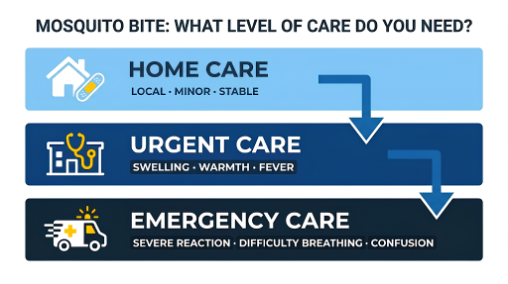
Home care is enough for:
- A bite that stays small and itches normally
- Symptoms that improve within a few days with basic care
Same-day urgent care is a good option if you notice:
- A large, spreading area of swelling that looks more like Skeeter Syndrome than a normal bite
- Increasing redness, warmth, or drainage that suggests infection
- A bite that hasn’t improved after a week
- Flu-like symptoms — fever, headache, body aches — starting in the days after a bite
A same-day visit at this stage can confirm whether you’re dealing with Skeeter Syndrome, a developing infection, or something else — and catching it early usually means a simpler treatment course.
Emergency care is the right call if you experience:
- Difficulty breathing
- Throat or facial swelling
- Hives covering large areas of the body
- A high fever with a stiff neck or confusion
- Sudden muscle weakness
These symptoms can develop quickly and point to a whole-body allergic reaction or a nervous system infection, either of which needs treatment right away — don’t wait for a next-day appointment to see if things settle down on their own.
How to Prevent Mosquito Bites This Season
The best way to avoid all of the above is to prevent bites in the first place. A few habits go a long way:
- Use an EPA-registered repellent containing DEET, picaridin, or oil of lemon eucalyptus on exposed skin, especially at dawn and dusk
- Wear loose, long-sleeved clothing when spending extended time outdoors
- Empty standing water from buckets, flowerpots, and gutters
- Repair any torn window or door screens
None of these steps is foolproof on its own, but layering a few together — repellent plus clothing plus reducing standing water around the house — offers far more protection than relying on just one, particularly during peak mosquito hours in the evening.
Frequently Asked Questions
How can I tell if a mosquito bite is serious?
A bite is more likely to be serious if it grows significantly larger than the original bump, becomes increasingly painful or warm over several days, develops red streaking or pus, or comes with fever or body aches. A bite that simply itches and fades within a week is not a cause for concern.
When should I go to the ER for mosquito bites?
Go to the emergency room for trouble breathing, swelling of the face or throat, widespread hives, a high fever with a stiff neck or confusion, or sudden muscle weakness. These can signal a severe allergic reaction or a serious infection affecting the nervous system.
How soon after a mosquito bite do you get sick?
Local skin reactions, including Skeeter Syndrome, usually appear within hours. Skin infections develop more gradually, often two days or more afterward. West Nile virus typically causes symptoms two to six days after a bite, though it can take up to two weeks.
How big can a mosquito bite get before it’s concerning?
A normal bite generally stays around the size of a pencil eraser. Swelling that grows to several inches across, especially if it’s warm, tender, or continuing to spread after a day or two, points to either Skeeter Syndrome or a developing infection and is worth having evaluated.
How do you treat a mosquito bite at home?
Wash the bite with soap and water, apply a cold compress, and use an over-the-counter antihistamine or hydrocortisone cream to relieve itching. Avoid scratching, which can break the skin and lead to infection. Most bites clear up within three to seven days.
Is it normal for a mosquito bite to get worse before it gets better?
Some increase in redness and itching over the first 24 to 36 hours is normal. Swelling that keeps expanding after that window, becomes warm or painful, or is joined by fever points to Skeeter Syndrome or infection rather than a typical bite running its course.
Can one mosquito bite make you sick?
Yes, though it’s uncommon. A single bite from an infected mosquito can transmit West Nile virus or other mosquito-borne illnesses. Most people who are infected never feel sick, but some develop flu-like symptoms days later, which is why it’s worth paying attention to how you feel in the one to two weeks after a bite, not just how the bite site looks.
Bottom Line
Most mosquito bites are nothing more than a passing itch. Watch how a bite changes over time — size, warmth, and how you feel overall — and let that guide whether home care is enough. If it’s growing, spreading, or you’re developing fever or body aches, don’t wait it out. Come see us.
| Worried About a Mosquito Bite?
If a bite is swelling, spreading, or you’re developing fever or body aches, ExperCARE offers walk-in urgent care with no appointment needed. We can evaluate symptoms, check for infection, and test for mosquito-borne illness when appropriate. |

